Sun burn
By definition sun burn is red, painful skin that feels hot to the touch and usually appears within a few hours after sun exposure and may take several days or longer to fade. It may include general fatigue and mild dizziness.
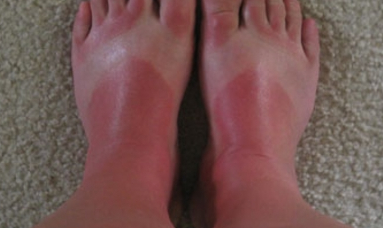
Brought about from an excess of UV radiation exposure, it can actually be life-threatening in an extreme situation.
However, when your exposure to the sun is managed more effectively for you and your skin type, a mild suntanned look can result.
Sun burn from excessive UV radiation
It is the leading cause of these skin tumors:
Use of sunscreen, especially if a non-toxic and non-chemical version, will assist hugely in preventing both a sun burn and the resultant skin cancers.
It is very important to make sure your choice of sunscreen protects you effectively from both UVA and UVB rays. Although the UVB rays are the ones doing the burning of your skin, the UVA rays are doing deeper damage, which you don't get to feel in something as tactile as a sun burn.
Besides the above skin cancers, if you do not manage your sun exposure and the result is a sunburn, you will increase your risk of premature aging with dry, wrinkled skin, liver spots, and actinic keratosis.
Sun burn protection
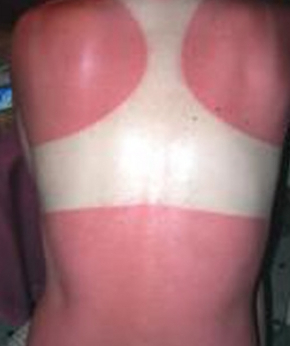 Easy to forget the sunscreen on your back and get badly sun burnt
In deciding on effective sun burn protection for yourself when exposed to these UV rays, consider the following aspects:
- Previously unexposed areas of your body without a tan from previous exposure will require far more protection than other areas that may not have been exposed before. eg. costume tan; shorts tan, shoe tan
- Different areas of your body are more sensitive than others e.g. face and neck are generally more sensitive than your back or your legs.
- UVB (the burning UV ray) exposure is strongest between 10 and 2, peaking at midday.
- UVB exposure is much higher in summer.
Further to these, the level of UV radiation is affected in the following ways:
- 85% increase from snow reflection
- 100% increase at 3000m altitude
- 25% increase from white-water reflection
- 80% of UV rays pass through cloud
- 20% from sand and grass reflection - and 40% when wet
- 15% reflection from concrete buildings
- 50% can be reflected into shaded area
- 50% UVB and 80% UVA passes through the upper 50cm of water
- 50% increase from water reflection
Sunburn prevention and healing
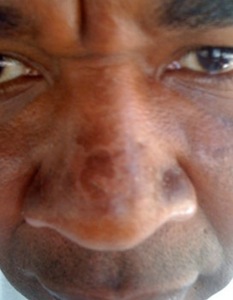 Even dark skin gets a sun burn
Your skin has the ability to protect itself from the damaging effects of the sun by increasing the production of melanocytes. These cells are created when you expose your skin to the sun and produce the dark brown pigment called melanin in the top layer of our skin - the epidermis.
We are all born with a certain amount of melanin, which dictates how light or dark our skin color may be. This extra melanin makes our skin look darker or 'suntanned'.
The melanin, or pigment, protects our deeper layers of skin from sun damage. The more melanin we have in our skin, the darker the skin color appears and with this, the more natural protection we have against sun damage.
This doesn't mean that people with a dark skin are not susceptible to sunburn and the related sun damage though! This man has dark skin, but his face still shows signs of sun damage with the irregular pigmentation and peeling on his nose.
Sun kisses vs sun burn damage
When I was young I used to get these gi-normous freckles on my nose after long sessions at the beach or swimming pool and I hated them. My mother placated me by calling them sun kisses.
These happen to people of all ages and all skin types and are relatively harmless. There are various ways to spot sun damaged skin that is more serious than sun kisses:
- Liver or age spot
Also known as solar lentigines, they are flat spots much darker than freckles and are brown, black or gray. Varying in size, they appear on areas most exposed to the sun - typically the face, hands, arms and upper back. They affect all ages but are common and numerous with repeated sun exposure and with advancing age. - Labial lentigo
These appear on the lips as a dark brown lesion, after repeated sun exposure. Mostly a single spot on the lower lips. Lips are really common areas for a blistering sunburn. - Solar elastosis
Occur after years of sun exposure that causes the skin's connective tissue, the collagen and elastin fibers lying in the deeper layer of skin (dermis), to break down and lose its strength and flexibility.
This is seen as vertical creases, deep wrinkles and loose or sagging skin. Typical as part of the aging process, it is way more advanced in some people than others. Sunburns logically hasten this process! - Melasma
Sometimes called chloasma or the "mask of pregnancy," it is a brown darkening of facial skin. An increase in estrogen or progesterone during pregnancy or while taking the Pill,or HRT, together with an increase in sunlight exposure are common causes.
Not necessarily a result of a sun burn, they usually occur on the cheeks, forehead, nose or chin. - Lentigo maligna
A type of melanoma typically developing in areas exposed to the sun regularly, like your face, hands, arms or legs.
Starting as a dark flat spot, it slowly darkens and enlarges.
Always see your doctor or dermatologist if you notice a new skin growth, a bothersome change in your skin, a change in the appearance or texture of a mole, or a sore that doesn't heal.
Pharmaceutical products can influence a sun burn
Sunburn can also be increased or even caused by some pharmacy products that make some people very sensitive to UV radiation. The ones to be especially careful with include:
- Certain antibiotics
- Oral contraceptives
- Tranquilizers
- Anti-malaria drugs
Natural sun burn remedies...
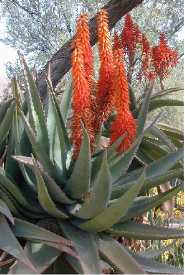
These contain properties that cool the burn and help reduce the inflammation:
- Aloe Vera or Aloe Ferox leaves
Cut a leaf off and peel and then and apply the fleshy gel directly to the skin. - Cucumber, apple or potato
Thinly slice and place on the burn for about 20 - 30 minutes. - Cooled black tea
Applied to the skin, this will soothe a sunburn. The tannic acid in tea helps remove heat from sunburnt skin. - Vinegar bath
An age old remedy when stinging and itchy.
2 cups of vinegar added to a cool bath allows the acetic acid to dull the sunburn pain, itching, and inflammation.
MAKE SPECIAL NOTE:
- Do NOT exfoliate the peeling skin as your skin is tender enough and needs time to heal.
- Sunburn can even create a fever, so rest the body and keep cool to allow for best recovery.
- Don't go into the sun again until the skin is well healed.
References:
Mayo clinic
Going deeper on sun protection:
→ Why Sunscreen Is Not Enough — what happens inside your skin that sunscreen cannot address
→ The South Atlantic Anomaly and Your Skin — the geomagnetic story behind rising radiation exposure in the southern hemisphere
Click here for this month's recommendation from the Environmental Working Group
Is your sunscreen making you sick?

How to embrace the sun safely

A primer on sun safety

What is your skin type?

Do you have a question or story about the benefits or dangers of sun exposure?
Share it by clicking here
Recent Articles


-
Proposed new FDA sunscreen regulations
Mar 20, 19 12:00 AM
The most important aspect for me of the proposed new sunscreen legislation from the FDA , is the fact that they are acknowledging that of the 16 approved active sunscreen ingredients that have been li… -
Why use a Natural Sunscreen with Organic Ingredients?
Apr 10, 16 10:32 AM
Natural vs chemical sunscreens. Don’t damage your skin with chemicals to avoid getting sunburnt. Zinc Oxide, as a mineral sunscreen, is 100% natural, provides a high level protection for both UVA and…
-
Anti-oxidants in sunscreens
Jan 13, 16 02:45 AM
Micronutrients are defined as minerals and vitamins essential for human survival. While necessary in our diets they can also play an important role in skincare as antioxidants, which help prevent oxid…